NoteLoom-AI Notetaker
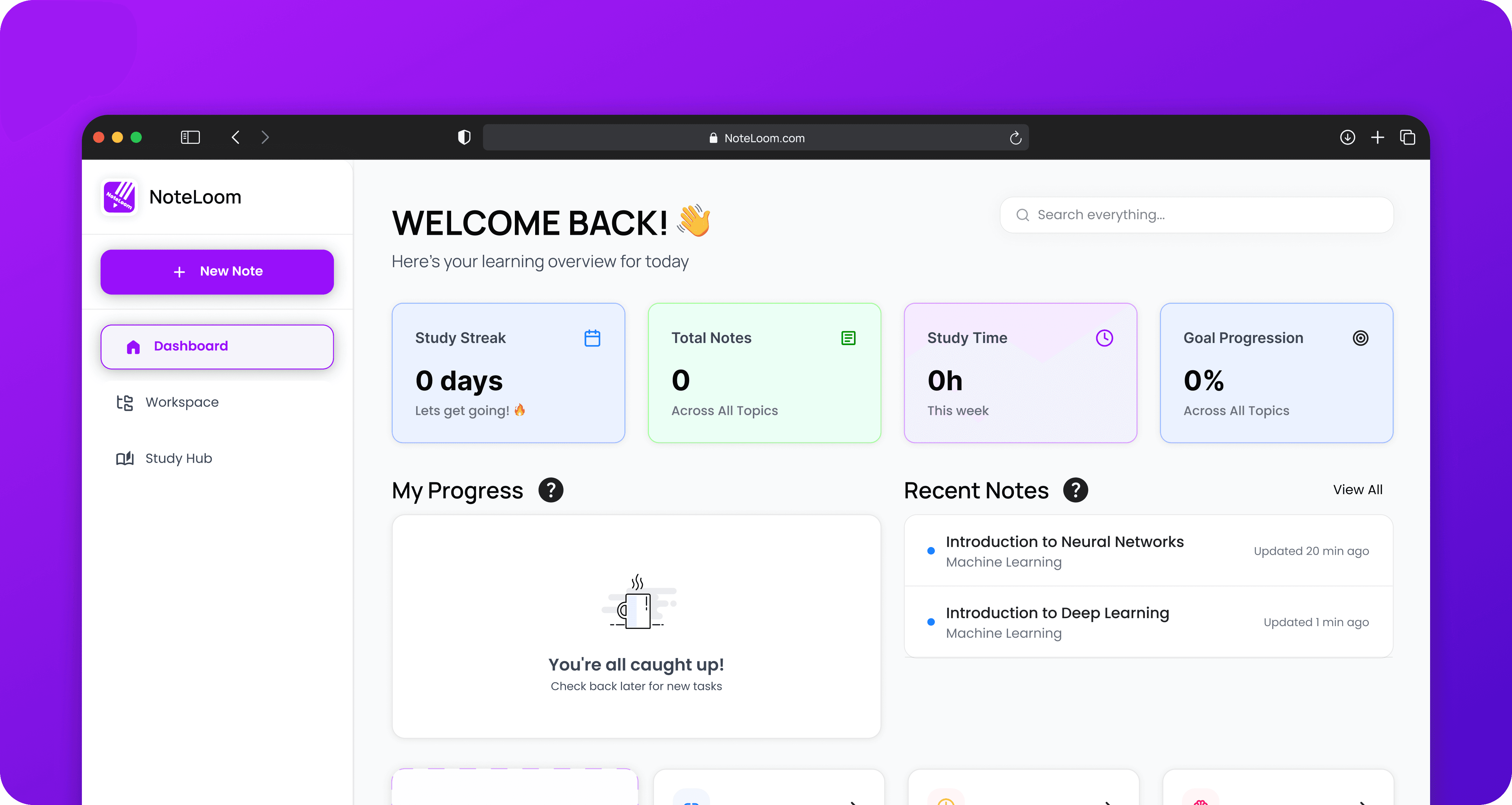
NoteLoom is an AI-supported study platform designed to help college students manage cognitive overload caused by fragmented study tools and fast-paced lectures. Over 10 weeks, my team and I researched, designed, and tested a solution that centralizes note-taking, summarization, and active recall. Through three rounds of iterative testing, we improved the System Usability Scale (SUS) score from 78.5 to 97.5, creating a tool that balances AI automation with human agency.
Role
Role
UX Researcher & Designer
UX Researcher & Designer
UX Researcher & Designer
Industry
Industry
Education
Education
Team Size
Team Size
6 members
6 members
Timeline
Timeline
Oct 2025 - Dec 2025
Oct 2025 - Dec 2025
Problem Statement
Problem Statement
College students today navigate a chaotic ecosystem of handwritten notes, PDF slides, and various AI tools. This fragmentation leads to high cognitive load and reduced learning efficiency.
Tool Overload
Tool Overload
Students juggle screenshots, slides, and separate AI tools (like ChatGPT), leading to scattered information.
Organization Debt
Organization Debt
Students lose significant time manually reorganizing material before they can even begin studying.
Speed v/s Structure
Speed v/s Structure
During fast-paced lectures, prioritizing capturing words over understanding, often resulting in messy, unusable notes.
UX Road Map
Our roadmap was divided into a three-phase User-Centered Design (UCD) process:

Aug-Sep
Empathize Phase

Aug-Sep
Empathize Phase

Oct-Nov
Ideate Phase

Oct-Nov
Ideate Phase
Nov-Dec
Prototyping & Testing Phase
Emphatize Phase
In this phase insights were gathered through 1-on-1 user interviews, by observing students' note-taking behavior, and by referring to research articles that focus on AI trust, cognitive load, and multimodal learning in students.
In this phase insights were gathered through 1-on-1 user interviews, by observing students' note-taking behavior, and by referring to research articles that focus on AI trust, cognitive load, and multimodal learning in students.
Primary Research Question:
Primary Research Question:
Primary Research Question:
How can an AI-supported study platform reduce cognitive load for college students while maintaining transparency and user control?
How can an AI-supported study platform reduce cognitive load for college students while maintaining transparency and user control?
How can an AI-supported study platform reduce cognitive load for college students while maintaining transparency and user control?


Sub Questions:
Sub Questions:
Sub Questions:
How can AI automation support learning without replacing active engagement?
What interface structures minimize organizational friction?
How can transparency mechanisms increase trust in AI-generated outputs?
How do affordance clarity and feature visibility affect usability under cognitive load?
How can AI automation support learning without replacing active engagement?
What interface structures minimize organizational friction?
How can transparency mechanisms increase trust in AI-generated outputs?
How do affordance clarity and feature visibility affect usability under cognitive load?
How can AI automation support learning without replacing active engagement?
What interface structures minimize organizational friction?
How can transparency mechanisms increase trust in AI-generated outputs?
How do affordance clarity and feature visibility affect usability under cognitive load?
Secondary Research
Secondary Research
Secondary Research
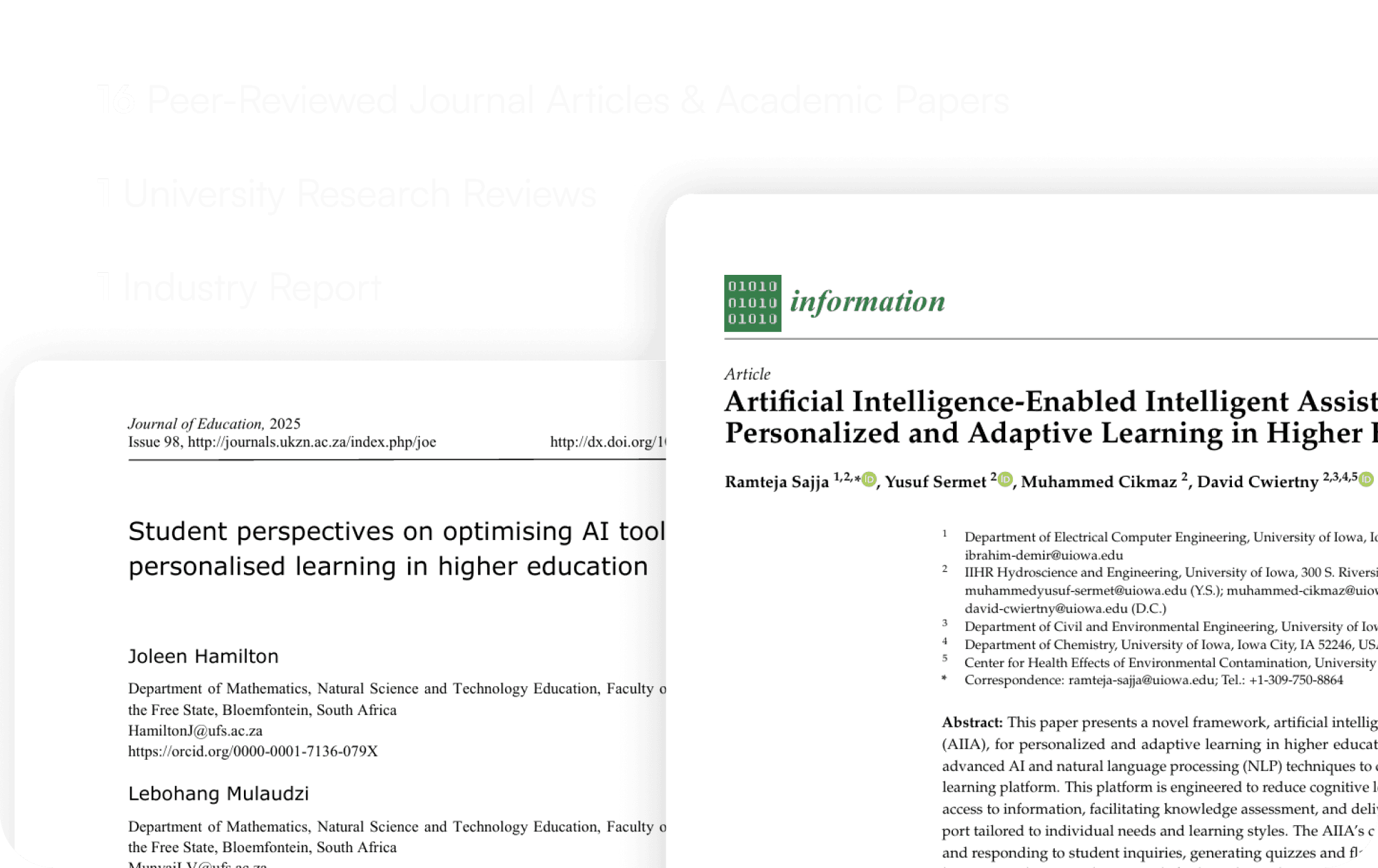
A total of 18 articles were reviewed on cognitive load, multimodal learning, and AI trust in students in higher studies and yielded 4 key insights.
A total of 18 articles were reviewed on cognitive load, multimodal learning, and AI trust in students in higher studies and yielded 4 key insights.
A total of 18 articles were reviewed on cognitive load, multimodal learning, and AI trust in students in higher studies and yielded 4 key insights.
Multimodal Learning Accelerates Retention:
Multimodal Learning Accelerates Retention:
We discovered that relying purely on massive blocks of text is an inefficient way to study. Our design needed to bridge the gap between text and visual representations.
We discovered that relying purely on massive blocks of text is an inefficient way to study. Our design needed to bridge the gap between text and visual representations.
"Explainable" and Controllable AI:
"Explainable" and Controllable AI:
A major insight was that students are skeptical of "black-box" AI tools. To build trust, NoteLoom had to be a transparent partner, not a Magic 8-Ball.
A major insight was that students are skeptical of "black-box" AI tools. To build trust, NoteLoom had to be a transparent partner, not a Magic 8-Ball.
Active Engagement vs. Digital Distraction
Active Engagement vs. Digital Distraction
While digital tools are necessary, they often become a source of distraction. We needed to design an environment that kept students actively engaged.
While digital tools are necessary, they often become a source of distraction. We needed to design an environment that kept students actively engaged.
Cognitive Load Optimization:
Cognitive Load Optimization:
Cognitive overload and disorganized study habits directly contribute to student burnout. NoteLoom needed to act as an organizational anchor.
Cognitive overload and disorganized study habits directly contribute to student burnout. NoteLoom needed to act as an organizational anchor.
1-on-1 User Interview
1-on-1 User Interview
1-on-1 User Interview
A total of 7 students aged 18-35 were interviewed to understand student behavior.
A total of 7 students aged 18-35 were interviewed to understand student behavior.
A total of 7 students aged 18-35 were interviewed to understand student behavior.
Efficiency & Overload
Efficiency & Overload
The cognitive cost of reorganizing notes across multiple apps frequently exceeds the perceived learning benefit.
The cognitive cost of reorganizing notes across multiple apps frequently exceeds the perceived learning benefit.
The Speed vs. Comprehension Deficit
The Speed vs. Comprehension Deficit
During fast-paced lectures, students abandon structured note-taking completely just to keep up, capturing fragmented text that lacks context when reviewed later.
During fast-paced lectures, students abandon structured note-taking completely just to keep up, capturing fragmented text that lacks context when reviewed later.
Trust & Transparency
Trust & Transparency
While students are eager for AI to save them time, they are highly skeptical of automated academic assistance that doesn't show its work.
While students are eager for AI to save them time, they are highly skeptical of automated academic assistance that doesn't show its work.
Stress Levels
Stress Levels
Messy, unstructured materials scattered across PDFs, screenshots, and word documents directly trigger anxiety.
Messy, unstructured materials scattered across PDFs, screenshots, and word documents directly trigger anxiety.

Affinity Diagram
Affinity Diagram
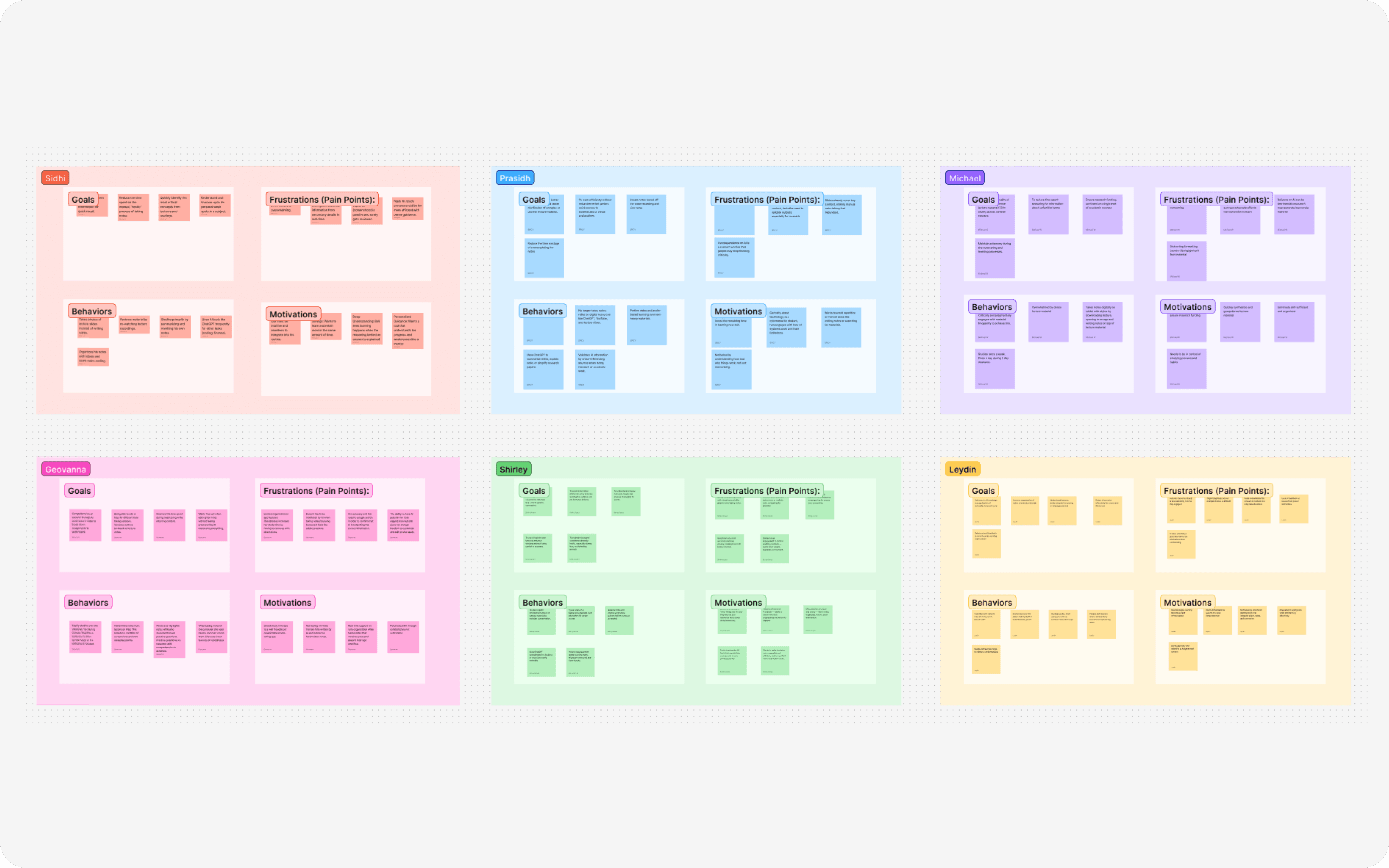
Based on the insights gathered from the interviews, each user's response was divided into 4 categories: Goals, Motivations, Need and Pain Points
Based on the insights gathered from the interviews, each user's response was divided into 4 categories: Goals, Motivations, Need and Pain Points
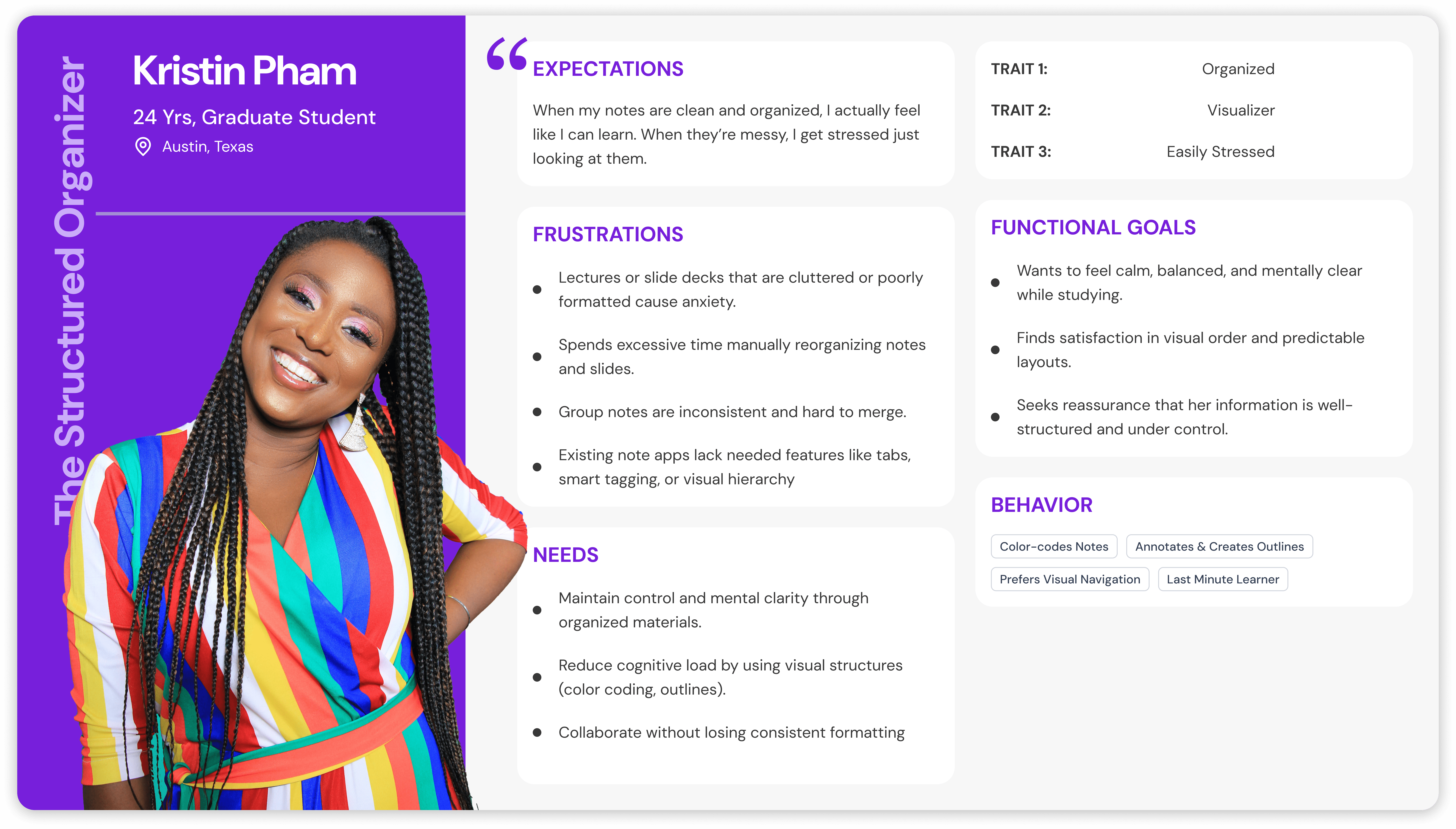
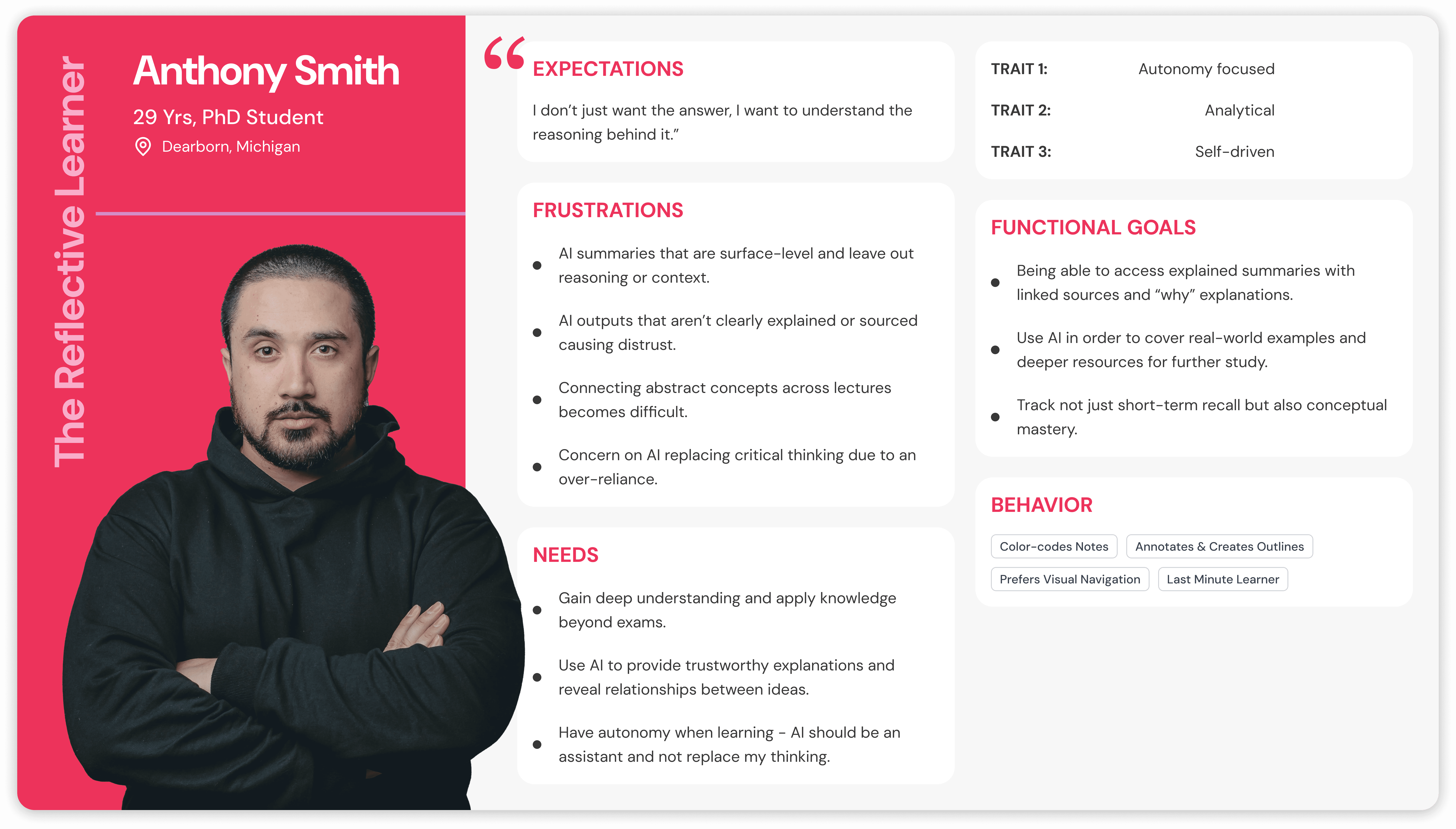
User Persona
User Persona
Three personas were created to guide the 3 Core feature pillars of the product: Automation, Organization, & Transparency
Three personas were created to guide the 3 Core feature pillars of the product: Automation, Organization, & Transparency

Ideation Phase
In this phase the Crazy 8s method (sketching 8 ideas in 8 minutes) was used to generate low-fidelity concepts addressing the 'How Might We' statements to satisfy the user needs. "AI Sketching" was also tried to expand divergent thinking, though human refinement was necessary to add empathy.
In this phase the Crazy 8s method (sketching 8 ideas in 8 minutes) was used to generate low-fidelity concepts addressing the 'How Might We' statements to satisfy the user needs. "AI Sketching" was also tried to expand divergent thinking, though human refinement was necessary to add empathy.
In this phase the Crazy 8s method (sketching 8 ideas in 8 minutes) was used to generate low-fidelity concepts addressing the 'How Might We' statements to satisfy the user needs. "AI Sketching" was also tried to expand divergent thinking, though human refinement was necessary to add empathy.
Emerging Key Points
Emerging Key Points
Derived through affinity mapping data, 5 key points were found based on three thematic pillars: Automation, Organization, & Transparency, which helped in transforming individual observations into a strategic foundation for the design requirements.
Derived through affinity mapping data, 5 key points were found based on three thematic pillars: Automation, Organization, & Transparency, which helped in transforming individual observations into a strategic foundation for the design requirements.
Lost time reorganizing scattered material vs learning.
Lost time reorganizing scattered material vs learning.
Visual learners depending on clear structure and hierarchy.
Visual learners depending on clear structure and hierarchy.
Reasoning & sources = Trust in AI.
Reasoning & sources = Trust in AI.
Dictated study flow v.s. Guided adaptive support
Dictated study flow v.s. Guided adaptive support
Reducing Effort without sacrificing comprehension.
Reducing Effort without sacrificing comprehension.
How Might We (HMW) Statements
How Might We (HMW) Statements
These statements were derived by inverting "Key Points" into generative questions, ensuring that every proposed feature remained a direct and purposeful response to a validated user need.
These statements were derived by inverting "Key Points" into generative questions, ensuring that every proposed feature remained a direct and purposeful response to a validated user need.
How might we help students stay visually organized across study material?
How might we help students stay visually organized across study material?
How might we create adaptive learning experience that suits multiple learning styles?
How might we create adaptive learning experience that suits multiple learning styles?
How might we design AI tools that explain reasoning transparently?
How might we design AI tools that explain reasoning transparently?
How might we promote collaboration while preserving personal study preferences?
How might we promote collaboration while preserving personal study preferences?
How might we reduce overload without diminishing comprehension?
How might we reduce overload without diminishing comprehension?
Crazy 8s Ideation & Voting
Crazy 8s Ideation & Voting
To rapidly ideate, the Crazy 8s method was used to sketch 48 concepts in eight minutes, grounded in specific user personas. By integrating AI-generated layouts, I balanced logical, human-centered workflows with divergent, unconventional patterns, leveraging AI for high-volume exploration and human empathy for strategic convergence.
To rapidly ideate, the Crazy 8s method was used to sketch 48 concepts in eight minutes, grounded in specific user personas. By integrating AI-generated layouts, I balanced logical, human-centered workflows with divergent, unconventional patterns, leveraging AI for high-volume exploration and human empathy for strategic convergence.
To rapidly ideate, the Crazy 8s method was used to sketch 48 concepts in eight minutes, grounded in specific user personas. By integrating AI-generated layouts, I balanced logical, human-centered workflows with divergent, unconventional patterns, leveraging AI for high-volume exploration and human empathy for strategic convergence.
Low-fidelity Wireframes
Low-fidelity Wireframes
The rapid sketches were translated into unique low-fidelity wireframes to establish a functional skeleton for the product. Low-fidelity wireframes were focused on defining the core architecture for note creation, AI-driven summaries, and flashcard generation. By prioritizing layout and logic over aesthetics, I ensured that the AI integration remained discoverable and the user flows remained centralized and efficient.
The rapid sketches were translated into unique low-fidelity wireframes to establish a functional skeleton for the product. Low-fidelity wireframes were focused on defining the core architecture for note creation, AI-driven summaries, and flashcard generation. By prioritizing layout and logic over aesthetics, I ensured that the AI integration remained discoverable and the user flows remained centralized and efficient.
The rapid sketches were translated into unique low-fidelity wireframes to establish a functional skeleton for the product. Low-fidelity wireframes were focused on defining the core architecture for note creation, AI-driven summaries, and flashcard generation. By prioritizing layout and logic over aesthetics, I ensured that the AI integration remained discoverable and the user flows remained centralized and efficient.
Prototype & Testing Phase
In this phase, mid-fidelity prototypes were developed to establish a functional skeleton and conduct the first round of usability testing using a within-subject design, focusing on structural logic over aesthetics. Building on these insights, I transitioned into high-fidelity iterations for subsequent testing rounds, refining the visual hierarchy and human-AI collaboration to ensure the final interface was both intuitive and trustworthy.
In this phase, mid-fidelity prototypes were developed to establish a functional skeleton and conduct the first round of usability testing using a within-subject design, focusing on structural logic over aesthetics. Building on these insights, I transitioned into high-fidelity iterations for subsequent testing rounds, refining the visual hierarchy and human-AI collaboration to ensure the final interface was both intuitive and trustworthy.
In this phase, mid-fidelity prototypes were developed to establish a functional skeleton and conduct the first round of usability testing using a within-subject design, focusing on structural logic over aesthetics. Building on these insights, I transitioned into high-fidelity iterations for subsequent testing rounds, refining the visual hierarchy and human-AI collaboration to ensure the final interface was both intuitive and trustworthy.
Round 1 Testing - Mid-Fidelity Prototype
Round 1 Testing - Mid-Fidelity Prototype
The first round of testing focused on validating the structural logic of the dashboard and core note-taking flow. The testing observation revealed two critical friction points:
The first round of testing focused on validating the structural logic of the dashboard and core note-taking flow. The testing observation revealed two critical friction points:
The first round of testing focused on validating the structural logic of the dashboard and core note-taking flow. The testing observation revealed two critical friction points:
1] Accessibility Issues: Users consistently struggled to title their notes because the input field lacked visual boundaries and mimicked static text.
1] Accessibility Issues: Users consistently struggled to title their notes because the input field lacked visual boundaries and mimicked static text.
1] Accessibility Issues: Users consistently struggled to title their notes because the input field lacked visual boundaries and mimicked static text.
2] Hidden AI Features: AI features were too hidden; high-value tools like auto-summaries and flashcards suffered from low discoverability because they were buried in nested menus.
2] Hidden AI Features: AI features were too hidden; high-value tools like auto-summaries and flashcards suffered from low discoverability because they were buried in nested menus.
78.5
78.5
78.5
SUS Score
SUS Score
5
5
5
Participants
Participants
95%
95%
95%
Task Completion Rate
Task Completion Rate
Round 2 Testing - High-Fidelity Prototype Version 1
Round 2 Testing - High-Fidelity Prototype Version 1
The second round of testing of the first high-fidelity prototype confirmed that the introduction of color improved the visual appeal and that streamlining the note-creation flow was successful. However, three critical friction points emerged:
The second round of testing of the first high-fidelity prototype confirmed that the introduction of color improved the visual appeal and that streamlining the note-creation flow was successful. However, it also has three critical friction points emerged:
The second round of testing of the first high-fidelity prototype confirmed that the introduction of color improved the visual appeal and that streamlining the note-creation flow was successful. However, three critical friction points emerged:
1] Weak Affordance: Users struggled to understand how to interact with and edit flashcards and AI summaries.
1] Weak Affordance: Users struggled to understand how to interact with and edit flashcards and AI summaries.
1] Weak Affordance: Users struggled to understand how to interact with and edit flashcards and AI summaries.
2] Visual Hierarchy: The title section after adding the 'Title' in the note lacked a distinguishing element, reducing its discoverability.
2] Visual Hierarchy: The title section after adding the 'Title' in the note lacked a distinguishing element, reducing its discoverability.
2] Visual Hierarchy: The title section after adding the 'Title' in the note lacked a distinguishing element, reducing its discoverability.
3] Feature Flexibility: Users wanted more control, specifically the ability to view flashcards in multiple formats and directly edit AI-generated summaries.
3] Feature Flexibility: Users wanted more control, specifically the ability to view flashcards in multiple formats and directly edit AI-generated summaries.
3] Feature Flexibility: Users wanted more control, specifically the ability to view flashcards in multiple formats and directly edit AI-generated summaries.
85.5
85.5
85.5
SUS Score
SUS Score
5
5
5
Participants
Participants
100%
100%
100%
Task Completion Rate
Task Completion Rate
Round 3 Testing - High-Fidelity Prototype Version 2
Round 3 Testing - High-Fidelity Prototype Version 2
The third and final round of testing served to validate the refined interaction models and affordances implemented after Round 2. The results overwhelmingly proved the success of the iterative process. The testing observation revealed the following points:
The third and final round of testing served to validate the refined interaction models and affordances implemented after Round 2. The results overwhelmingly proved the success of the iterative process. The testing observation revealed the following points:
The third and final round of testing served to validate the refined interaction models and affordances implemented after Round 2. The results overwhelmingly proved the success of the iterative process. The testing observation revealed the following points:
Resolved Friction Points:
1] Accessibility Issues: Users consistently struggled to title their notes because the input field lacked visual boundaries and mimicked static text.
Resolved Friction Points:
1] Clear Affordances: The addition of explicit hint text completely resolved previous confusion around the note title field.
1] Accessibility Issues: Users consistently struggled to title their notes because the input field lacked visual boundaries and mimicked static text.
1] Clear Affordances: The addition of explicit hint text completely resolved previous confusion around the note title field.
2] Surfaced AI: Summaries and flashcards were no longer hidden, resulting in effortless discoverability.
1] Accessibility Issues: Users consistently struggled to title their notes because the input field lacked visual boundaries and mimicked static text.
2] Surfaced AI: Summaries and flashcards were no longer hidden, resulting in effortless discoverability.
97.5
97.5
97.5
SUS Score
SUS Score
5
5
5
Participants
Participants
100%
100%
100%
Task Completion Rate
Task Completion Rate
High Fidelity Prototype
High Fidelity Prototype
This video shows the finalized high-fidelity prototype with incorporated feedback from all the usability testing.
This video shows the finalized high-fidelity prototype with incorporated feedback from all the usability testing.
Key Findings
Key Findings
Explicit Affordances are Non-Negotiable::
Explicit Affordances are Non-Negotiable::
Explicit affordances are non-negotiable::
Subtle design cues completely failed with our fast-paced user group. We learned that clear, visible boundaries and explicit text nudges are required to drive engagement and prevent task abandonment.
Subtle design cues completely failed with our fast-paced user group. We learned that clear, visible boundaries and explicit text nudges are required to drive engagement and prevent task abandonment.
Visibility Drives
Adoption:
Visibility Drives
Adoption:
Users overwhelmingly relied on features available at the top-level interface and actively avoided nested menus or ambiguous buttons. Surfacing high-value AI actions directly next to the editor instantly removed friction
Users overwhelmingly relied on features available at the top-level interface and actively avoided nested menus or ambiguous buttons. Surfacing high-value AI actions directly next to the editor instantly removed friction
The Automation vs. Control Tension:
The Automation vs. Control Tension:
While digital tools are necessary, they often become a source of distraction. We needed to design an environment that kept students actively engaged.
While digital tools are necessary, they often become a source of distraction. We needed to design an environment that kept students actively engaged.
AI Use in the Project
AI Use in the Project
AI Use in the Project
To accelerate the workflow and expand the conceptual landscape, several AI tools were strategically integrated throughout the project lifecycle.
To accelerate the workflow and expand the conceptual landscape, several AI tools were strategically integrated throughout the project lifecycle.
To accelerate the workflow and expand the conceptual landscape, several AI tools were strategically integrated throughout the project lifecycle.
Usage
Usage
• Crazy 8s idea generation
• Feature comparison
• UI flow visualization
AI-Teaming
"AI sped up layout ideas… but lacked empathy.”
“It sparked ideas, not decisions.”
Key Takeaway
Key Takeaway
AI = divergent thinking (quantity)
• Humans = convergent decisions (quality)
• Empathy > automation
Conclusion
Conclusion
Through three rounds of iterative, human-centered design, NoteLoom evolved from a concept into an intuitive, cognitively supportive study platform. By actively listening to user friction and responding with explicit interaction cues and surfaced navigation, NoteLoom transforms a highly fragmented study process into a centralized, efficient workflow.
Ultimately, NoteLoom succeeds because it strikes a delicate balance, utilizing AI to reduce busywork while preserving the transparency and user agency required for true academic comprehension. The success of this approach is reflected in the usability test metrics, jumping from a baseline usability score to a final SUS score of 97.5. NoteLoom demonstrates the immense potential of future-facing, AI-supported tools when they are strictly anchored to diverse human learning styles.
Through three rounds of iterative, human-centered design, NoteLoom evolved from a concept into an intuitive, cognitively supportive study platform. By actively listening to user friction and responding with explicit interaction cues and surfaced navigation, NoteLoom transforms a highly fragmented study process into a centralized, efficient workflow.
Ultimately, NoteLoom succeeds because it strikes a delicate balance, utilizing AI to reduce busywork while preserving the transparency and user agency required for true academic comprehension. The success of this approach is reflected in the usability test metrics, jumping from a baseline usability score to a final SUS score of 97.5. NoteLoom demonstrates the immense potential of future-facing, AI-supported tools when they are strictly anchored to diverse human learning styles.